
If you've never heard of Skool, you're about to. And if you have, you may not yet understand what's actually happening inside it — or why it matters for how you lead your congregation.
Skool is one of the fastest-growing online community platforms in the world. It hosts thousands of paid and free communities across nearly every topic imaginable. And in the spirituality category, something significant is happening that pastors need to see clearly.
This isn't about technology. It's about where your members are forming their deepest spiritual habits — and whether your church has a presence in that space, or whether someone else does.
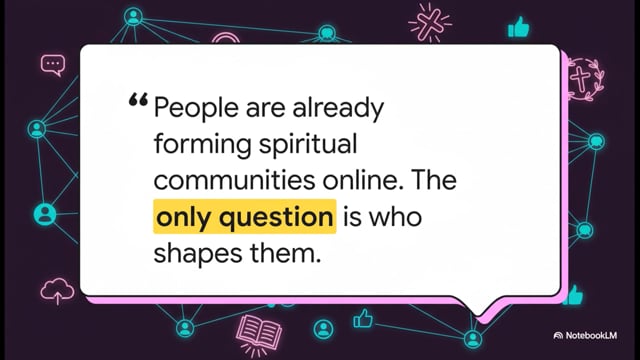
"People are already forming spiritual communities online at massive scale. The only question is whether those communities are shaped by the local church or by someone else's ideology."
What's Actually Happening on Skool
A review of Skool's spirituality communities reveals two categories existing side-by-side, often using identical language — "transformation," "community," "awakening," "healing," "purpose" — but operating from very different foundations.
Christian communities with real traction
New-age and manifestation communities — often using Christian language
Many of these communities use explicitly Christian language — "divine," "healing," "awakening," "purpose," "transformation" — while operating from frameworks rooted in new-age mysticism, manifestation theology, and esoteric practices. A church member searching for "spiritual community online" could land in any of these spaces, often without recognizing the theological difference. The language sounds familiar. The theology is not.
The Data Pastors Can't Ignore
This isn't a fringe phenomenon. The scale is significant and the trajectory is clear:
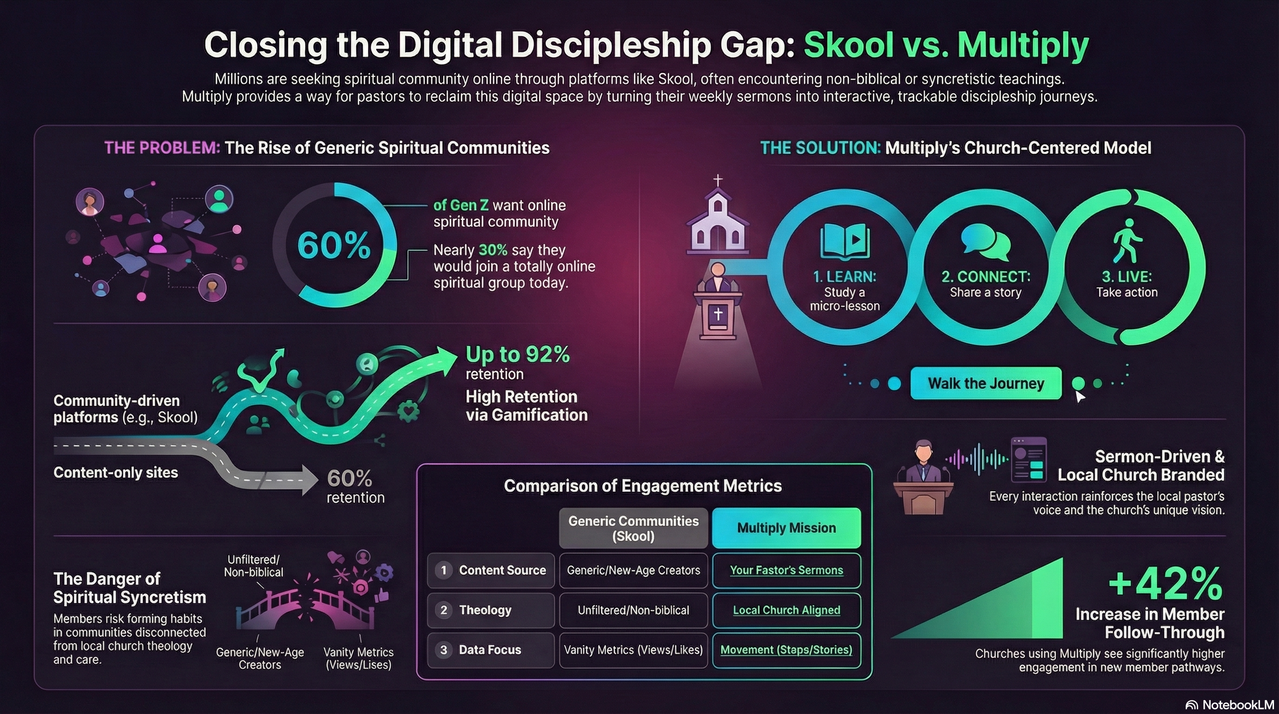
Springtide research confirms what pastors are witnessing: nearly 60% of Gen Z young people are interested in a totally online spiritual community, with 28% saying they would actually join one. This generation expects spiritual formation to have a digital component. They will seek it out whether the church provides it or not.
The Skool data simply shows where they're ending up when the church doesn't provide an alternative.
Why Skool Works — and What the Church Can Learn
Before responding with alarm, it's worth asking: Why is Skool so effective? Because the answer shapes what pastors should do next.
Skool's success is built on principles that are actually theologically sound — they've just been applied outside the church:
- Community over content. Skool's highest-retention communities achieve 85-92% month-over-month retention — far exceeding content-only platforms. People don't stay for the videos. They stay for the relationships and the rhythm.
- Clear, repeatable rhythm. The most successful communities have a predictable weekly structure. Members know what to expect, when to show up, and what happens next.
- Story-sharing and real interaction. Skool's forums, leaderboards, and discussion features create a sense of belonging. People share their experiences and feel known.
- Simple onboarding. Anyone can join. The barrier is low. The engagement structure does the work of keeping people.
- Practical next steps. The communities that grow fastest give members something to do — not just something to watch or read.
These are not Skool's inventions. These are the principles of the early church. What Skool has done is apply them with technological discipline and consistency. The question is whether the local church will do the same — before someone else does it first.
Skool vs. Multiply: Two Very Different Approaches
| Category | Skool | Multiply |
|---|---|---|
| Theological foundation | Varies widely — creator-defined | Your pastor's biblical teaching |
| Community identity | Tied to platform brand or influencer | Fully branded to your local church |
| Discipleship model | Self-guided, choose-your-own spirituality | Guided weekly: Learn, Connect, Live It Out |
| Data focus | Engagement metrics, leaderboard activity | Movement data: steps, stories, gifts |
| Pastoral accountability | None — no connection to local church leadership | Direct connection to your pastoral team |
| Content source | Creator's content or community posts | Your pastor's actual sermons |
| Retention model | Gamification, leaderboards, consumption | Relationship, story-sharing, real-world action |
| New member onboarding | Generic welcome sequence | Auto-enrolled church-branded 3-week journey |
| Mobile access | Requires app or browser login | One link, no app, no login required |
| Pricing (for church) | Free–$99/month per community created | $297/month flat — full discipleship system |
The Pastoral Gap — and the Pastoral Response
The Skool data exposes a real gap. Not a technology gap — a presence gap. When churches don't provide a simple, accessible digital pathway for discipleship beyond Sunday, their members don't stop searching. They just search somewhere else.
The communities waiting for them aren't all dangerous. But many are theologically adrift — using the language of faith while operating from frameworks that are fundamentally incompatible with the gospel. And they're good at what they do. They are warm, structured, rhythmic, and accessible. They meet the hunger that Sunday alone doesn't satisfy.
If your members are hungry for guided spiritual community beyond Sunday, and the church doesn't provide it — who will? Skool has already answered that question. The High Vibe Tribe has 80,300 members. It is free. It is warm. It is mobile. It shows up every week. Your church can do the same — with biblical truth and pastoral care as the foundation.
What Multiply Provides That Skool Cannot
Multiply is not a generic community platform. It is a sermon-centered, church-branded discipleship system that meets the same hunger driving people to Skool — but rooted in the local congregation's theology, pastoral care, and weekly teaching rhythm.
Every week, Multiply automatically converts your pastor's sermon into a guided member experience that members can engage in five minutes on their phone. No app. No login. No additional program for your staff to run. The content comes from the same teaching your congregation just heard on Sunday — so the discipleship is continuous, not disconnected.
Churches that implement Multiply see:
- +42% follow-through on new member journeys
- +47% average engagement across the congregation
- 2.3× next-step clicks from livestream viewers who would otherwise disappear
- 4+ hours saved per week by consolidating disconnected discipleship tools
Multiply also offers The Multiply Circle at multiplymission.org/circle — a pastor-led peer community where church leaders share best practices, case studies, and templates. Because pastors shouldn't be experimenting with digital discipleship alone while secular and new-age communities scale rapidly.
The Question to Bring to Your Leadership Team
Here's a practical exercise: Open Skool's spirituality discovery page with your leadership team and spend 15 minutes reviewing what you find. Ask these questions together:
- What unmet need are these communities addressing that we should be meeting?
- Are any of our members likely engaging with these spaces?
- What would it take for our church to provide something this accessible and this rhythmic?
- What happens after Sunday in our congregation — is there a clear guided pathway, or does the sermon evaporate by Monday?
If those questions surface discomfort, that's useful. The digital discipleship gap is real, and it's growing. But it is not inevitable. Pastors who take it seriously now — while the landscape is still being shaped — will have a significant advantage over those who discover the problem after their members have already formed spiritual habits elsewhere.
The Choice Is Straightforward
Option one: Hope that Sunday is enough, and watch members form their deepest spiritual habits in communities you didn't create, with theology you don't control, under leadership outside your pastoral care.
Option two: Provide a simple, mobile-first discipleship rhythm that extends your preaching into a trackable, week-long journey your whole church can follow — anchored in your theology, your voice, and your community.
People are seeking spiritual community online. Make sure it's yours.
30 days free. No card.
We build first — you decide after.
Book a 15-minute Discovery Call and we'll show you exactly what Multiply would build from one of your recent sermons. No pitch. No demo. The actual product — applied to your church's voice.