
There is a moment that happens in nearly every congregation, week after week, that no one talks about in staff meetings.
The service ends. The worship was good. The sermon was strong. People file out into the parking lot, trading small talk about lunch plans and football scores. And somewhere in that crowd — not obviously, not dramatically — someone walks to their car alone, gets in, and drives home to a space where no one will know what stirred in them during that message.
They are not disengaged. They are not backsliding. They are not even necessarily unhappy with your church. They are lonely. And unless you have a way to see it, you will not know until they stop coming.
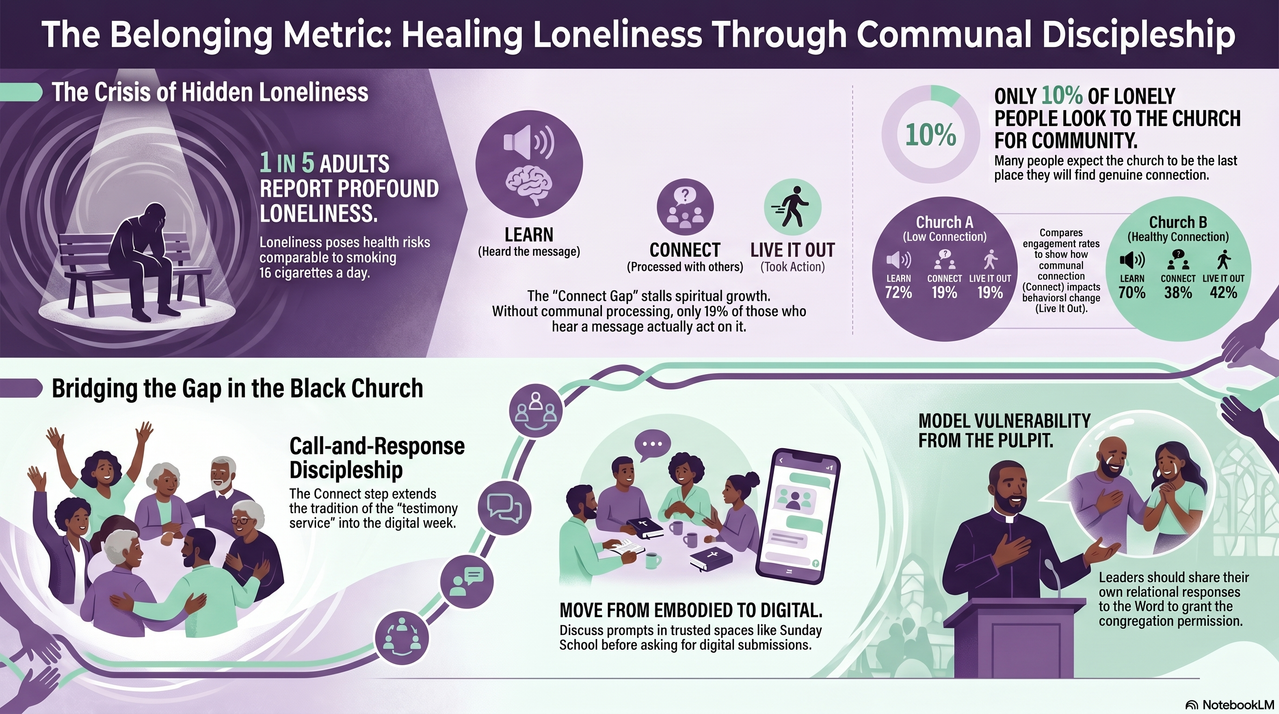
This is not a fringe situation. A 2024 Harvard study found that 21% of adults report profound loneliness — with younger adults among the loneliest of all. The U.S. Surgeon General has declared it a national health epidemic, comparing its effects to smoking up to 15 cigarettes a day — greater than the risks associated with obesity and physical inactivity. And here is the part that should stop every pastor cold: a person can be surrounded by people and still feel profoundly lonely. Researchers call it "existential loneliness" — a feeling of disconnection not just from others, but from the world itself.
Your sanctuary is full of it.
That last number deserves a second read. Only 10% of lonely people are looking to the church for connection. Despite a growing epidemic of loneliness, only 10% report going to church to find community — possibly because people expect the church to be the last place they'll find it.
And that is the pastoral emergency hiding inside a metric most churches aren't tracking.
The Connect Step Is Not a Feature. It Is the Relational Bridge.
Multiply's three-step weekly framework — Learn, Connect, Live It Out — is built around a truth that the early church understood instinctively: learning and community are not sequential. They are simultaneous. You cannot fully separate hearing the Word from processing it with others without losing something essential in the transaction.
"They devoted themselves to the apostles' teaching and to fellowship, to the breaking of bread and to prayer."
— Acts 2:42Notice that Acts 2:42 describes devoted people doing both things at once — the teaching and the fellowship — in a single breath, without pause. The apostolic teaching did not conclude and then fellowship optionally follow. They were intertwined. The relational membrane was the medium through which the teaching became formation.
The Connect step is the digital expression of that ancient pattern. It does not ask members to discuss theology abstractly. It asks them to surface the relational implications of what they just heard: Who in your life came to mind during this message? What would change in your closest relationships if you acted on this week's Live It Out step?
These are not small group icebreakers. They are the specific questions that move the Word from the mind — where the Learn step places it — toward the relationships and behaviors where formation actually happens. And the Connect engagement rate is the metric that tells you whether that bridge is being crossed.
What the Data Shows When Connect Is Low
Across churches using Multiply's Evidence of Movement platform, the Stage Progression analysis consistently shows the same pattern: the gap between Learn completion and Live It Out commitment is largest when Connect engagement is lowest.
This is not coincidental. It is behavioral science made pastoral.
Social accountability is one of the strongest predictors of whether an intended action becomes an actual behavior. The person who completes Learn and reads the Live It Out step alone is relying entirely on personal discipline to follow through. The person who also responded to the Connect prompt — who shared the message with someone, received a response that deepened their understanding — now has social context around the action they're about to take. That context significantly increases the probability of follow-through.
Think of it this way. The Learn step opens a door. The Live It Out step is a step through it. But the Connect step is what gives someone the courage to actually walk through — because they know someone else is walking with them.
When the relational bridge is crossed, obedience follows. Same sermon. Same congregation size. The only variable is whether people processed it together.
Connect Is Also a Pastoral Safety Signal
There is a dimension of the Connect metric that goes beyond discipleship statistics. It is a belonging safety signal — one that can give you pastoral lead time you cannot get any other way.
Members who are going through personal difficulty — grief, relational conflict, financial strain, spiritual doubt — tend to go quiet in the Connect step before they go quiet anywhere else. The Connect prompt asks for vulnerability. Vulnerability requires trust and emotional bandwidth. When both are depleted, the first thing to disappear is the willingness to share.
When a previously active Connect participant stops responding, it is often the first platform-visible signal that something significant is happening in their life — sometimes weeks before their Sunday absence becomes noticeable. Cross-referenced with your full engagement data, this pattern can give you the lead time to make a pastoral call before the spiral has gone far.
This is not surveillance. This is shepherding. The Connect rate is the platform-visible edge of belonging — and the pastor who reads it carefully is the pastor who doesn't lose sheep quietly.
What Connect Healthy Ranges Actually Look Like
Connect engagement typically runs 10–20 percentage points below Learn completion across healthy Multiply churches. This gap is expected. The relational vulnerability required by the Connect step is higher than the cognitive engagement required by the Learn step. Not every member who re-engages the message mid-week will be ready to process it publicly in the same week.
The diagnostic threshold to watch is the 25-point gap. If Learn is at 55% and Connect is at 25%, something specific is blocking the relational step. It is not ambiguity about the message. It is not a technology problem. It is almost always one of three things:
The fix: Audit your last four weeks of Connect prompts. Are they experiential and personal, or doctrinal and analytical? The best prompts are simple, relational, and specific. They don't require eloquence. They require honesty.
The fix: Read a Connect response from the pulpit. Not a testimony — a Connect response. Something that shows the congregation that the question you're asking is one you're willing to answer yourself. Then invite them to answer it. Model vulnerability before you measure it.
The fix: Bring the Connect prompt into the rooms the congregation already trusts — small group opening questions, Sunday school class, the deacon board meeting. Let the conversation happen in person first. Then the written submission becomes a natural extension of what was already said out loud, not a substitute for it. When that translation happens, Connect engagement rises rapidly.
The fix: Don't pivot the curriculum or change the platform. Be consistent. Continue the three moves below. Consistency of practice — not speed of adoption — is the strongest predictor of whether a new behavior becomes habitual. Give it 60–90 days before concluding anything.
What to Do, By Stage — Practical Moves for Every Church
Where your Connect engagement sits right now changes what your next move should be. Here's the triage by stage.
What's happening: The platform may be new. The culture may not yet have permission. The prompts may be asking for more than the congregation is ready to give publicly. None of this is failure — it is the starting condition. But it calls for immediate pastoral attention.
Your Three Moves Right Now
"Lord, the people You've given me are more isolated than I know. Open their lips. Give me the courage to go first — to model the vulnerability I am asking of them. Let the Word that arrived on Sunday begin finding its way into the conversations of this week."
What's happening: The same people tend to be engaging week after week. The platform has reached your early adopters — the 13–16% who follow trusted leaders into new practices. The early majority is watching. They're waiting to see if this is real, if it lasts, and whether people they respect are genuinely changed by it.
This is the hardest ground to cross in any cultural change. Your task right now is not to push harder on the platform. It's to make the early adopters visible.
Your Three Moves Right Now
"Lord, I see a few who are moving. Show me how to honor what You're doing in them and use it to reach the rest. Let the testimony of the willing become the invitation to the watching."
What's happening: About one in four of your members is processing the Word in community. The gap between Learn and Live It Out should be narrowing. Testimonies are beginning to appear weekly. This is real movement — but it is fragile. The culture around it is still being established, and the temptation to add complexity too soon is real.
Your Three Moves Right Now
"Lord, let the rhythm hold. Let what is forming not plateau. Stir in us a deeper hunger — not just to hear the Word but to say it to one another, to walk it out together, to become the kind of people whose obedience is visible."
What's happening: More than a third of your congregation is processing their formation in community. The gap between hearing and doing is narrowing week over week. Testimonies are flowing. And something is beginning to happen that no single metric fully captures: discipleship is becoming part of your congregation's self-understanding.
They are not "people who attend a church with an app." They are people who take a weekly step of obedience, together. That identity shift is the most durable thing Multiply can produce — and it begins here.
Your Three Moves Right Now
"Lord, do not let us sit on what You have built. Let the belonging in us become a gift to congregations still waiting to see it. Keep us from the pride of arrival. The work of formation is never finished this side of glory."
The Black Church Tradition and the Connect Step
For churches rooted in Black church tradition, the Connect step carries particular theological and cultural weight that deserves its own attention.
The Black church has always understood that faith is processed communally — that the sermon is not finished when the preacher sits down. It continues in the testimony service. The prayer circle. The post-service conversation on the church steps. The phone call on Wednesday afternoon between two deacons who are still sitting with what was preached. Faith in the Black church tradition is not a private transaction with a distant God. It is a communal practice in a God who is present, and who is witnessed to — together.
"The call-and-response tradition at the heart of Black church worship is itself a model of what the Connect step is attempting to extend: the congregation's voice completing the call the preacher initiated."
When a Connect prompt asks "What stirred in you during this message?" it is not asking something new. It is asking what the testimony service has always asked. It is extending the call-and-response into the week — inviting the communal voice that has always been part of how the Black church processes the Word.
This means that for Black church leaders, low Connect engagement may signal not a lack of willingness to share, but a mismatch between the platform's form and the congregation's formation tradition. The Black church processes vulnerability in embodied, communal, oral contexts before it processes it in written, individual, digital ones.
The pastoral response is not to push harder on the digital form. It is to bring the Connect conversation into the embodied spaces the congregation already trusts — into small group opening questions, into Sunday school, into the deacon board meeting — and allow the digital submission to become a natural extension of those conversations, not a substitute for them.
When that translation happens, Connect engagement tends to rise rapidly. Not because the congregation became more comfortable with technology, but because the technology finally caught up with where the community already was.
The Deepest Purpose of the Belonging Metric
Return for a moment to the person in the parking lot.
The one who walked out of your service moved. Who heard something that stirred in them. Who got in their car and drove home to a space where no one would ever know what the message awakened.
Harvard researchers found that 65% of lonely adults feel "fundamentally separate or disconnected from others or the world," and more than half said they struggle to share their true selves with anyone. Many lonely people are not isolated. They are present in the room. They attend services. They wave hello. But no one knows what God is doing in them. No one asks. And they have never been given a structure through which to say it.
The Connect metric is the platform-visible edge of that epidemic. When the Connect rate rises — when more of your congregation is processing their formation in relationship with others — the pastoral work happening in the platform is addressing the deepest need the congregation carries: the need to be known, not just informed. To be accompanied, not just taught.
To find that what the message stirred in them was also stirring in the person sitting three pews away.
That discovery — I am not alone in this — is not a byproduct of discipleship. It is discipleship. The Connect metric is the evidence that it is happening.
"For where two or three gather in my name, there am I with them."
— Matthew 18:20The Connect step is not asking your congregation to gather physically. It is asking them to be present to one another around the Word. To let the message that arrived on Sunday keep arriving — in a response, in a question, in a vulnerability offered across whatever distance separates them. When that happens, Jesus said He shows up too. The Connect rate is the measure of whether that gathering is occurring.
Count it carefully. Tend it faithfully. And when it rises, know that the belonging your congregation has been quietly starving for is finally being fed.
30 days free. We build first.
You decide after.
Book a 15-minute Discovery Call and we'll take one of your recent sermons and show you exactly what Multiply would build from it — before you make any decision. No demo. No pitch. Just the product, applied to your church.