The Learn, Connect, Live It Out™ Framework
A multidisciplinary synthesis of adult learning, behavioral psychology, and spiritual formation—designed to permanently close the gap between Sunday’s inspiration and Monday’s reality.
The Crisis of Passive Learning
The prevailing ecclesiastical model of discipleship relies disproportionately on the passive transmission of information, typically localized within a 45-minute weekend sermon. While functionally efficient for mass communication, it is critically flawed when evaluated against the neurocognitive realities of adult learning and human behavior.
The Learn, Connect, Live It Out™ framework provides a scientifically and theologically rigorous corrective to this structural deficit. By sequencing the spiritual formation process into three distinct, non-negotiable phases, the framework explicitly dismantles the Sunday-to-Monday theological dualism.
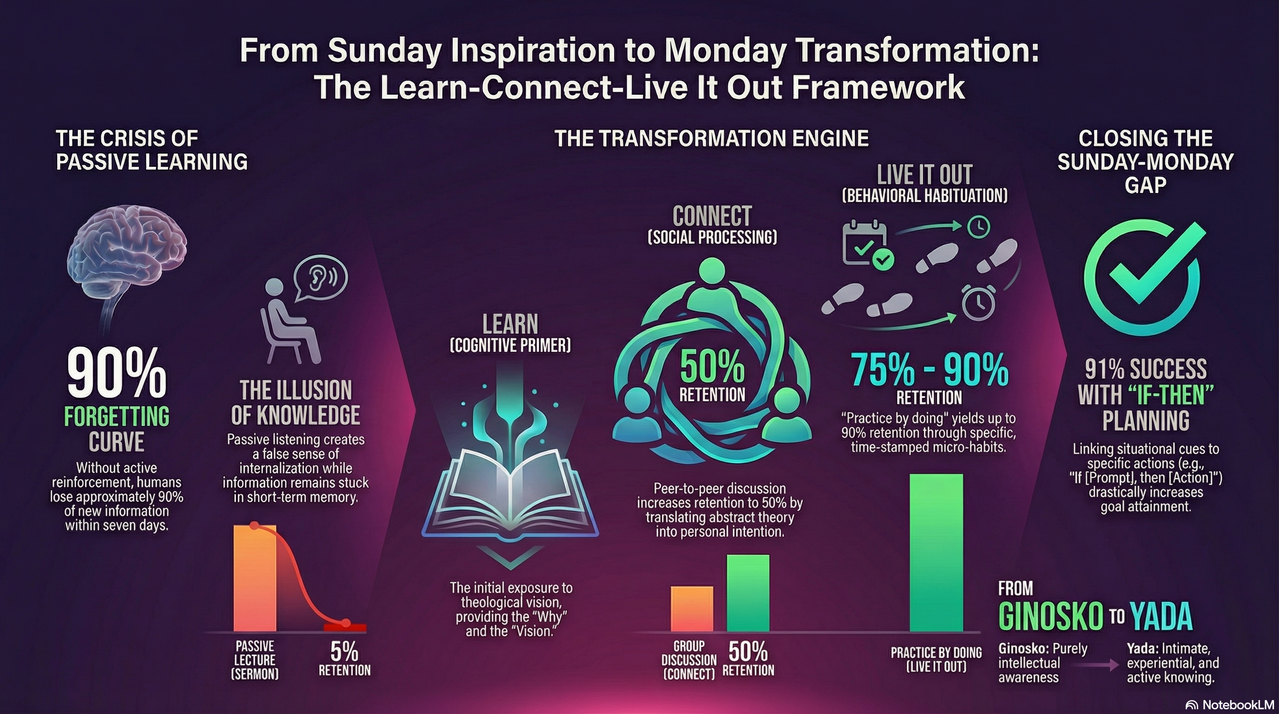
Research confirms that human beings lose up to 90% of newly acquired information within a single week if it is not actively reinforced. The traditional sermon attempts to instantiate long-term character change through a delivery mechanism that guarantees a near-total cognitive failure rate by the following Saturday.
Fundamentally, this framework does not merely augment the weekend sermon; it rescues it from inevitable cognitive decay. It maps flawlessly to proven behavioral models, proving that sustained spiritual change requires a choreographed progression from passive reception to active, relationally accountable execution.
The Three Pillars of Validation
The framework operates as an interconnected assembly line of human transformation. It bridges the gap between academic rigor and pastoral reality across three specific disciplines.
Transitioning from Passive to Active
Adult learning theory, pioneered by Malcolm Knowles, posits that adults process information fundamentally differently than children. They are problem-centered and require self-directed autonomy. Furthermore, David Kolb's Experiential Learning Cycle dictates that profound learning must move from abstract conceptualization (the sermon) to reflective observation and active experimentation.
Adults don't learn by just sitting and listening—they learn by doing. If your congregation doesn't verbally process the message (Connect) and physically practice it (Live It Out), they will retain less than 5% of what you preached by Wednesday.
Engineering Behavioral Compliance
Dr. BJ Fogg’s Behavior Model (B=MAP) dictates that behavior only occurs when Motivation, Ability, and a Prompt converge simultaneously. Because Sunday's motivation is volatile, the Live It Out phase drastically reduces the "Ability" hurdle by requiring just one micro-action. By anchoring it to a specific time and place, it utilizes Peter Gollwitzer’s theory of "Implementation Intentions" (If-Then planning)—a strategy clinically proven to raise goal attainment to 91%.
People don't fail to apply the sermon because they lack faith; they fail because the application is too vague. Telling them to "be more prayerful" doesn't work. Telling them to "pray for 60 seconds right after you start your car on Monday morning" turns inspiration into an automatic habit.
Reclaiming Historic Ecclesiology
The framework reclaims the ancient Hebrew epistemology of yada—the concept that true knowledge is experiential and active. The Connect phase mirrors the ancient pedagogical practice of Havruta, utilizing the friction of peer discussion to transform the text from an abstract study object into a living, accountable reality, aligning with Dallas Willard’s V.I.M. pattern (Vision, Intention, Means).
Spiritual formation was never meant to be a solo sport. You cannot disciple someone purely from a stage. To truly know God's word, people have to wrestle with it together in community, shifting the burden of discipleship from the pulpit to the people.
Defeating the "Monday Drop-Off"
The paramount genius of the framework lies in its strictly linear sequence. No single phase can function effectively without the other two.
Without Learn, the framework lacks a theological trajectory, degrading into secular self-help. Without Connect, the adult learner is isolated, and motivation cannot survive the stress of the workweek unaided. Without Live It Out, the learner acquires cognitive knowledge but fails to achieve experiential reality, generating theological complacency.
By insisting on the complete sequence, the framework takes the high motivation generated on Sunday, processes it through the stabilizing machinery of the community, and locks it into the environment via an if-then implementation intention. When Monday morning arrives, the believer relies on a pre-determined behavioral anchor, successfully closing the Sunday-Monday gap.
Framework Data Map
A visual synthesis of the cognitive, psychological, and theological mechanisms that power the framework's retention architecture.
Read the Academic Whitepaper
Access the complete multidisciplinary research, including full citations, behavioral modeling matrices, and theological deep-dives.